
Table of Contents
Google Jagger Update
Google Big Daddy Update
Google Vince Update
Google Payday Loan Update
Google Quality Update
Google Jagger Update (2005)
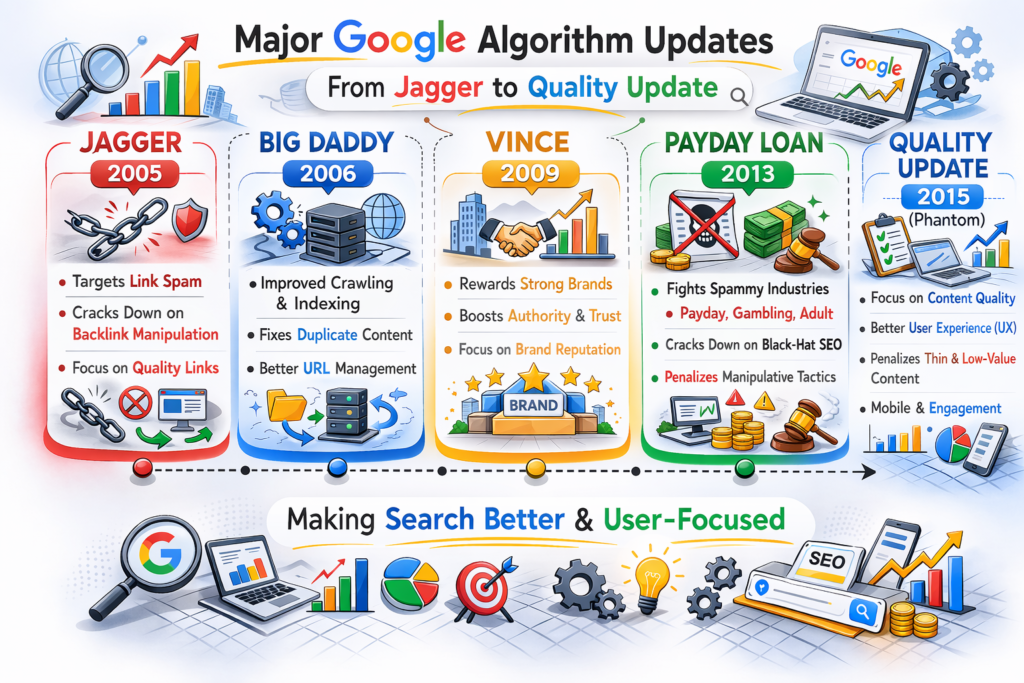
The Google Jagger update, rolled out in 2005, was one of the first major algorithm changes targeting spammy link practices. At the time, many websites ranked highly by buying backlinks, participating in link farms, and using manipulative anchor text strategies. Jagger aimed to clean up these tactics and improve link quality evaluation.
This update focused on three key areas: low-quality backlinks, duplicate content, and unnatural link building. Websites engaging in reciprocal linking schemes or paid links without relevance saw significant ranking drops. Jagger also improved Google’s ability to detect canonicalization issues, helping search engines better understand duplicate URLs.
For digital marketers, Jagger marked a turning point. It reinforced the importance of earning links naturally rather than manipulating rankings. The update laid the groundwork for future link-focused algorithm changes and pushed the industry toward ethical SEO practices built on authority, relevance, and trust.
Google Big Daddy Update (2006)
The Big Daddy update, launched in 2006, was more of an infrastructure change than a traditional algorithm update. Unlike Jagger, which focused heavily on link spam, Big Daddy improved how Google handled crawling, indexing, and URL canonicalization.
Big Daddy enhanced Google’s ability to identify redirects, manage duplicate content, and process large-scale websites efficiently. It improved how Google interpreted 301 and 302 redirects, which helped websites consolidate link equity properly. Sites with poor technical structure, messy redirects, or duplicate URL versions were significantly affected.
For SEO professionals, Big Daddy emphasized the growing importance of technical SEO. Clean site architecture, proper redirect management, and consistent URL structures became critical ranking factors. This update demonstrated that search visibility depends not only on content and backlinks but also on strong technical foundations.
Big Daddy helped modernize Google’s indexing system and paved the way for more advanced algorithm updates in the years that followed.
Google Vince Update (2009)
The Google Vince update, introduced in 2009, shifted search rankings in favor of strong, established brands. After Vince, well-known companies began appearing more prominently in competitive search results, even for generic keywords.
Unlike earlier updates that targeted spam, Vince focused on trust and authority signals. Google began rewarding brands with strong domain authority, offline presence, and user trust. Smaller affiliate sites and thin-content websites experienced ranking drops, especially in high-competition industries.
This update highlighted the importance of brand building in SEO. It became clear that having quality backlinks alone was not enough; businesses needed credibility, reputation, and consistent user engagement. Signals such as branded searches, mentions, and authority links became more influential.
For digital marketers, Vince reinforced the connection between SEO and branding. Strong brand recognition, trustworthiness, and user experience became essential components of long-term search success.
Google Payday Loan Update (2013)
The Payday Loan update, released in 2013, targeted extremely spammy queries and industries known for aggressive black-hat SEO tactics. Sectors such as payday loans, gambling, adult content, and pharmaceuticals were particularly affected.
Google designed this update to combat keyword stuffing, cloaking, link schemes, and low-quality content that dominated high-risk search terms. The goal was to improve the quality of results for queries that were often manipulated by spam-heavy websites.
Unlike broader updates like Panda or Penguin, Payday Loan specifically targeted niche industries with high spam levels. Websites relying on manipulative SEO tactics saw dramatic ranking losses, while legitimate businesses with quality content gained better visibility.
For marketers, this update reinforced the risk of black-hat SEO. It emphasized that Google continuously monitors spam trends and updates its algorithm accordingly. Sustainable SEO practices and ethical optimization remain the safest long-term strategy.
Google Quality Update (Phantom Update – 2015)
The Google Quality Update, often referred to as the Phantom Update (2015), focused on improving the overall quality of content in search results. Unlike penalty-driven updates, this change rewarded high-quality, user-focused websites.
The update targeted thin content, excessive ads, poor user experience, and low-value pages created solely for rankings. Websites with shallow articles, misleading layouts, or heavy ad placements experienced traffic declines.
Quality signals such as content depth, relevance, readability, and engagement became increasingly important. Sites offering comprehensive, informative, and well-structured content benefited significantly.
For digital marketers, this update reinforced a major shift toward user-centric SEO. Instead of optimizing purely for keywords, brands needed to focus on delivering real value. Strong content strategy, improved UX design, and audience-focused writing became central to sustainable growth in search rankings
Conclusion
Google’s algorithm updates from Jagger and Big Daddy to Vince, Payday Loan, and the Quality Update clearly show the evolution of SEO over time. What began as a fight against link spam and technical manipulation gradually shifted toward brand authority, user trust, and high-quality content.
Each update reinforced one important message: shortcuts in SEO do not last. Early updates targeted unnatural backlinks and technical loopholes, while later changes prioritized credibility, expertise, and user experience. Google’s ultimate goal has always remained the same: delivering the most relevant, trustworthy, and valuable results to users.
For digital marketers, these updates highlight the importance of sustainable strategies. Strong technical foundations, ethical link building, brand development, and high-value content creation are essential for long-term success.
Understanding these algorithm changes not only helps us learn from the past but also prepares us for future updates. In SEO, adapting to change isn’t optional; it’s the key to staying competitive in an ever-evolving digital landscape.